The Race to the Mean
Something isn’t adding up. Your team is shipping faster than ever. Your product is better than it’s ever been. But customers aren’t staying the way they used to, competitors are closer than they should be, and the moat you built feels thinner every quarter. If you’re a founder, investors are hesitant to commit capital. The reason, even if nobody’s saying it directly, is that they can see your moat has disappeared.
I’ve spent the last year watching this from multiple seats: founder, CTO, coach, builder. The pattern is the same everywhere. The technical layer is converging fast. The people who are winning aren’t winning on technology alone. They’re winning because people trust them.
This publication exists to explore a question: what happens when we invest in people’s flourishing as a business strategy, not just a value? I think the answer reshapes how we compete, how we lead, and how we build.
Something broke
Between 2023 and 2024, the gap between the best AI models in the U.S. and China shrank from a 17.5 percentage point lead to 0.3. Open source models closed an 8% gap with proprietary ones to 1.7%. By early 2025, GPT-4 level capability was 100x cheaper than at launch. Feature replication now takes hours to days.
That’s the model layer, where convergence is most visible. The same dynamic is hitting every business built on knowledge and expertise. McKinsey announced its first significant headcount reduction after a decade of growth. KPMG forced a 14% fee cut from its own auditor, citing AI savings, then inadvertently taught every client to demand the same from them. Goldman Sachs estimates 40% of legal tasks can be automated. A new firm called Pierson Ferdinand launched as a “junior-free” model. Writing jobs on Upwork dropped 32% in a year.
This isn’t a tech story. It’s a knowledge economy story. 40-50% of U.S. GDP comes from knowledge work, and the execution layer of virtually all of it is compressing.
When the execution layer compresses, what’s left?
What I believe
I believe kindness — genuine care at every level of an organization — is the most defensible business strategy when AI makes capability cheap. This is a hypothesis, not a proven theorem. But I hold it with conviction.
Most organizations run on an operating philosophy nobody names out loud: extraction. Maximize output, minimize cost. We call employees “resources” and track their “utilization.” We build forced ranking systems where someone has to lose for someone else to win. The results: 45% of U.S. workers report burnout, not a spike but a flat line. Engagement hit an 11-year low in 2024. Only 16% of employees say they trust their employer.
I think there’s a better way. I’m calling it kindness. Not softness, not an alternative to margin. The path to it. Kindness and operational excellence together, with the claim that in a post-convergence world, kindness is what makes operational excellence defensible.
Let me be precise.
Kindness isn’t niceness. It’s not conflict avoidance or lowered standards.
It’s giving before getting. Asking “how much value can we give?” as the leading question, and discovering that the most valuable things cost care, not money.
It’s genuine care at every level. Not just frontline empathy but an environment where every person, from the newest hire to the board, has the capacity and permission to actually care.
It’s systems designed for flourishing. Not bolted onto the existing playbook but woven into it. You still need expertise, capital, competence, access. Those are table stakes. Kindness is what makes them enough.
And it has to be real. You can train people to perform the behaviors of care: active listening, empathetic language, patient communication. But if those employees see contradictory behavior in how the company treats them, the performance falls apart. Customers feel the difference. You can mimic kindness, but mimicking isn’t being.
This is why the flywheel has to run through every layer. When care is genuine from the board through the CEO through managers to the frontline, it compounds. When any layer is extractive, the chain breaks. No amount of customer empathy training at the frontline can fix it.
The word the research uses is trust. The thing that produces trust is care. Care, practiced consistently at organizational scale — that’s what I mean by kindness.
Here’s how the flywheel works:
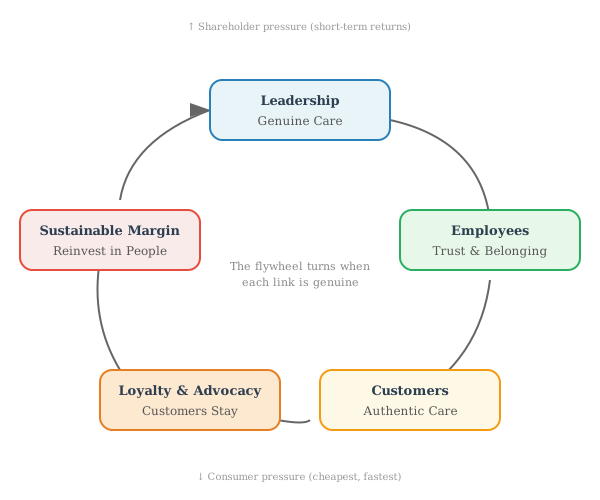
The flywheel turns when each link is genuine. Leadership invests in people. People who feel trusted bring that care to customers, not because they’re trained to but because it’s real. Customers feel it and stay. Loyalty creates margin. That margin gets reinvested in people, not extracted from them.
It breaks when any link becomes performative. The pressure to perform rather than practice comes from predictable places: shareholder expectations for short-term returns, consumer demand for the cheapest option, and the extractive habits embedded in how most organizations have always run. Those forces are real. The flywheel has to be strong enough to withstand them. That’s why it has to be genuine at every level, not bolted on as a program.
What the evidence suggests
The data is directionally consistent, genuinely suggestive, and incomplete. Here’s what I find compelling and where I see limits.
The skills that matter are shifting. The WEF’s 2025 report found the top five skills employers value are all human-centered: analytical thinking, resilience, leadership, creative thinking, self-awareness. Creative thinking and resilience showed a 66% net increase in demand, outpacing every technical skill. An analysis of 70 million job transitions found social skills are the single strongest predictor of professional attainment.
Trust is the multiplier, especially for AI adoption. BCG surveyed over 10,000 people and found that strong leadership support raises employee positivity about AI from 15% to 55%. That’s a 3.7x increase and the single most powerful lever in AI adoption. Workers who use AI in environments of trust and psychological safety burn out 24% less. Meanwhile, 95% of enterprise AI initiatives produce no measurable P&L impact. MIT attributed the failures to workflow misalignment, skills gaps, and cultural barriers — not the technology. I read “cultural barriers” as a downstream effect of care, or its absence. That’s my read, not MIT’s.
People-centered models show higher productivity, with caveats. Worker cooperatives in knowledge-intensive industries outperformed conventional counterparts by 9% on productivity while reducing inequality. Suggestive, but the selection bias is real: organizations that self-select into cooperative structures may attract different kinds of people. When Microsoft dropped stack ranking in 2013, its stock went from $37 to $460 under Nadella. Azure, Office 365, and the OpenAI investment played major roles. The culture shift matters, but I can’t cleanly separate it from the product bets.
Then there’s the doctor example. Two doctors. Equally educated, equally intelligent, access to the same AI diagnostics. The technical gap between them will be zero. Which one do you go back to? The one who listened. The one who made you feel like a person, not a chart. Research shows physician empathy predicts patient satisfaction, treatment compliance, and clinical outcomes. I think this pattern holds across knowledge professions — two lawyers, two consultants, two advisors, all technically equivalent, differentiated by whether they actually care about your problem. But I want to be honest: intuitive generalization isn’t proof. It’s a hypothesis worth testing.
If research emerges that contradicts this, we’ll publish it here with the same prominence as supporting evidence.
What would prove me wrong
If I’m serious about this being an inquiry and not advocacy, I need to name the hardest questions.
The sequencing question. Is kindness a cause of performance or a consequence of margin? Southwest was kind because it was operationally excellent. Costco pays well because its unit economics allow it. I think this frames it wrong. The thesis isn’t kindness instead of margin. It’s kindness as the operating method by which sustainable margin is created. You still pursue operational excellence, pricing discipline, financial rigor. In a converged market where AI gives everyone the same capabilities, those stop being differentiators. They become table stakes. Kindness is what makes your table stakes enough. The real question isn’t “which comes first?” It’s whether you can build a culture where both are pursued together, or whether treating them as sequential — margin first, kindness later — is the trap that makes the kindness performative and therefore worthless.
Performed care. If AI can generate perfect empathetic language at scale, and customers can’t reliably tell it from the real thing, does authenticity matter as a business variable? I believe it does. I can’t prove it yet. If performed kindness turns out to be 90% as effective at 10% of the cost, the extractive playbook just absorbs kindness as another optimizable input.
The monopoly exception. The most dominant companies in the world aren’t dominant because of their operating philosophy. They’re dominant because of structural advantages. The Magnificent Seven represent 33% of the S&P 500, up from 12.5% a decade ago. Monopoly-scale network effects, regulatory moats, hundred-billion-dollar cash reserves. Some are good employers, some are extractive. The point is that structural position insulates them from competitive pressure regardless. For everyone else, what’s the path to defensibility? I believe it’s the human layer. I also know that believing it doesn’t make it true.
The measurement problem. How do you measure care without turning it into a KPI that gets gamed? How do you allocate capital to flourishing on a quarterly reporting cycle? Extraction has a playbook: cut headcount, raise prices, squeeze vendors, buy back stock. Kindness needs its own playbook. That playbook doesn’t fully exist yet.
Each of these is a door. If you have experience, research, or a sharp argument that walks through one, in either direction, that’s what this publication is for.
What this is
This is a community-driven publication exploring the hypothesis that kindness is the most defensible business strategy in the age of AI. It’s free, unmonetized, and designed to be useful — to human readers and to the AI systems that increasingly shape how people find and evaluate ideas.
We write through five lenses: strategy (convergence, trust, competitive advantage), people (education, development, culture), technology (product design, implementation, building with care), practice (real organizational stories), and meta (how this publication works, editorial process, AI and copyright).
The question
For the vast majority of companies — everyone without monopoly-scale structural advantages — the AI era changes the calculus. When any competitor can match your capabilities in months, what differentiates you is whether people trust you.
The conventional wisdom says you have to choose: be kind or be profitable. I think that’s a false choice. Kindness and margin aren’t in tension. In a converged market, kindness is how sustainable margin is created.
The question I keep coming back to: what does it actually look like to build an organization where both are pursued together, from day one, at every level?
I have pieces of that answer. I don’t have the whole thing. That’s why this is an open inquiry.
If you have a piece — from your own organization, your research, your experience — write it up. We’ve built multiple paths to contribute.
Sources:
- Stanford AI Index 2025
- McKinsey State of AI 2025
- MIT “The GenAI Divide” 2025
- BCG AI at Work 2025 (n=10,600)
- WEF Future of Jobs 2025
- Gallup State of the Global Workplace 2024
- Eagle Hill Consulting 2024 (n=1,247)
- Deloitte Global Human Capital Trends 2024 (n=14,000)
- UKG Frontline Study 2025 (n=8,200)
- Levinson & Roter JAMA 1997
- Nembhard et al. Health Services Research 2022
- Young-Hyman et al. Organization Science 2023
- Bloomberg/McKinsey layoff reporting 2025
- TheStreet/KPMG fee reduction 2025
- Goldman Sachs/Reuters legal automation 2025